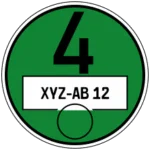
Abolishing an Umweltzone ends the sticker requirement in that former zone, not across Germany. The UBA overview updated on 26 August 2026 lists 35 active and 23 abolished zones.
Abolished Umweltzonen
| City or area | Abolished |
|---|---|
| Balingen | 1 November 2020 |
| Erfurt | 1 May 2021 |
| Heidelberg, Karlsruhe, Pfinztal, Schramberg | 1 March 2023 |
| Ilsfeld, Schwäbisch Gmünd, Urbach, Wendlingen | 1 May 2023 |
| Heidenheim, Heilbronn, Herrenberg, Leonberg / Hemmingen and surrounding area | 1 January 2024 |
| Hannover | 22 February 2024 |
| Reutlingen, Tübingen, Ulm, Neu-Ulm | 4 June 2024 |
| Mannheim, Mühlacker | 1 August 2024 |
| Freiburg | 22 April 2025 |
| Mainz | 1 October 2025 |
A shared area can cover several municipalities. For Leonberg / Hemmingen and the surrounding area, use the UBA map to confirm the precise former boundary.
What abolition means for drivers
If the destination is inside a former zone, you do not need a new sticker solely for that abolished Umweltzone. Check the full route: another city on the way can still require it.
You need not remove a valid sticker because one city abolishes its zone. It remains usable elsewhere if the number matches the current plate and it is legible.
Abolished and never established are different
Do not label every large city without a sticker requirement an abolished Umweltzone. Hamburg’s official website, for example, says it has no Umweltzone. The history of another traffic restriction does not establish an old sticker zone.
Where the requirement continues
Active zones include Berlin, Munich, Leipzig, Regensburg and Frankfurt am Main. Munich and Stuttgart also have separate diesel restrictions. See the German guide and sticker rules.
How to verify the position
Open the official UBA map and table, find the city, distinguish aktiv from aufgehoben, and check the abolition date and any newer city notice. Observe current signs and other local restrictions.